
Algorithmic Precision.
Zen-Like Execution.
Systematic trend-following strategies for crypto markets.
A decade of quantitative research, distilled into a TradingView strategy suite.
Designed for TradingView strategy execution and automation.
The Three Temperaments of Trend Trading
ZenAlpha strategies share one philosophy: trend following.
What differs is their trading temperament.
Markets reward different behaviors at different moments. ZenAlpha provides three systems with distinct personalities.
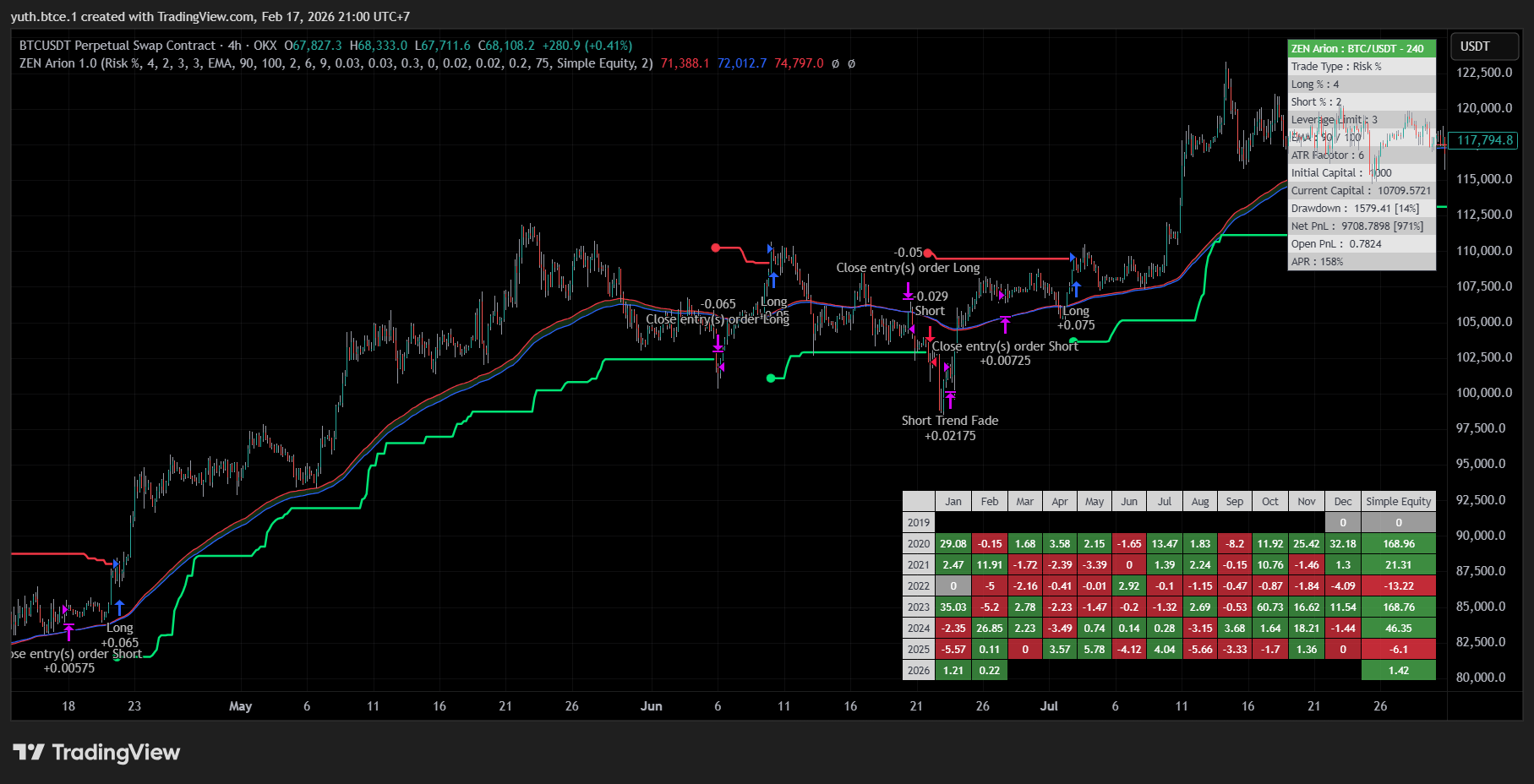
Arion
The Patient Trend Hunter
Arion waits for strong confirmation before entering a trade. Signals are less frequent, and sideways markets may produce several stop-outs.
But when a true trend emerges, Arion is designed to stay with the move and capture the majority of the expansion.
Best suited for traders who prefer clarity over frequency.
Key Traits
- Slow but decisive entries
- Designed for large market moves
- Strong trend capture
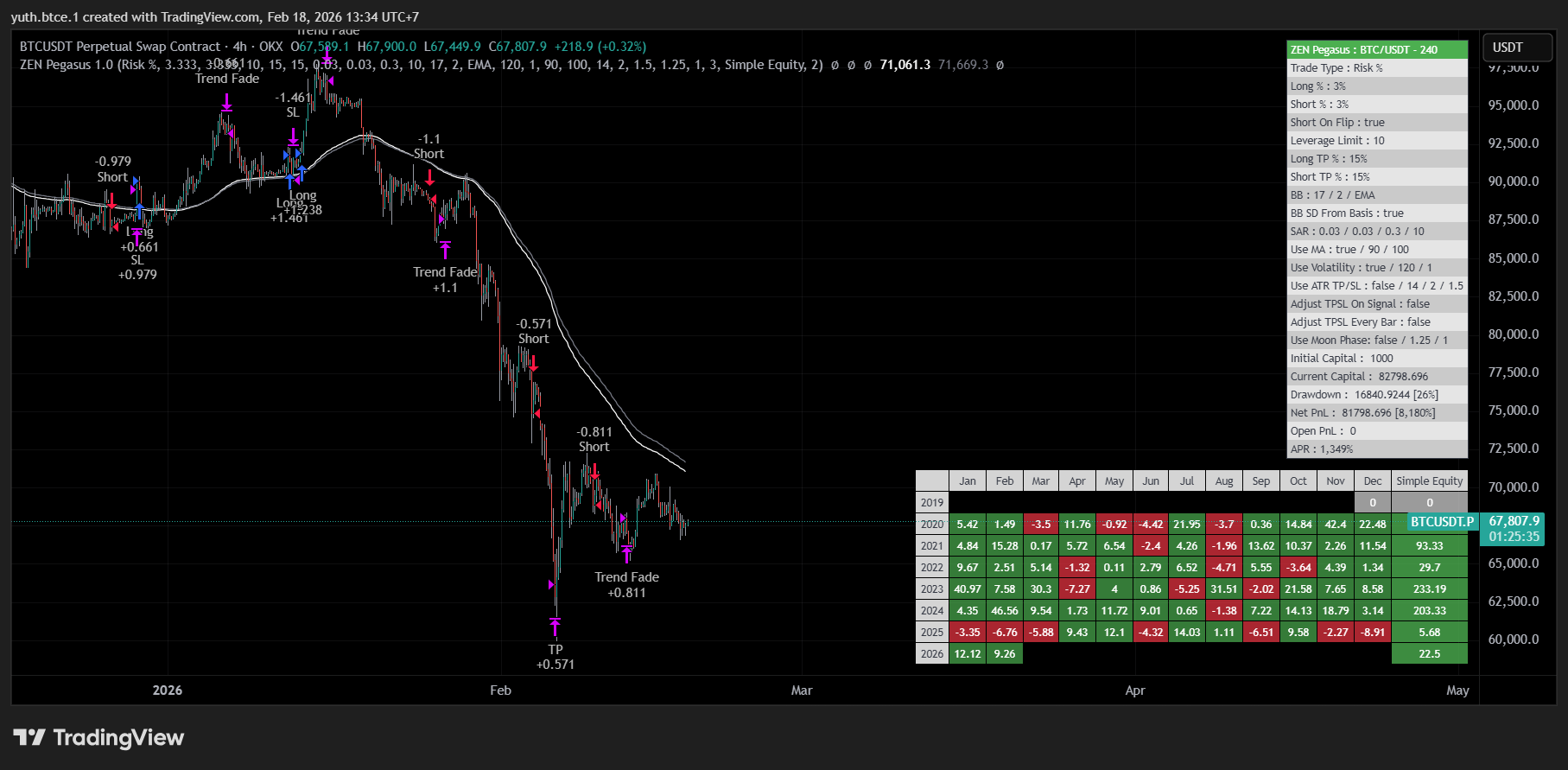
Pegasus
The Efficient Trend Rider
Pegasus is built for higher trading efficiency. Instead of waiting for a single large move, Pegasus participates in multiple waves within a trend.
It uses structured entries and tighter risk control to repeatedly engage the market, allowing traders to harvest trend momentum in stages.
Key Traits
- More frequent signals
- Shorter stops and defined exits
- Wave-by-wave trend participation
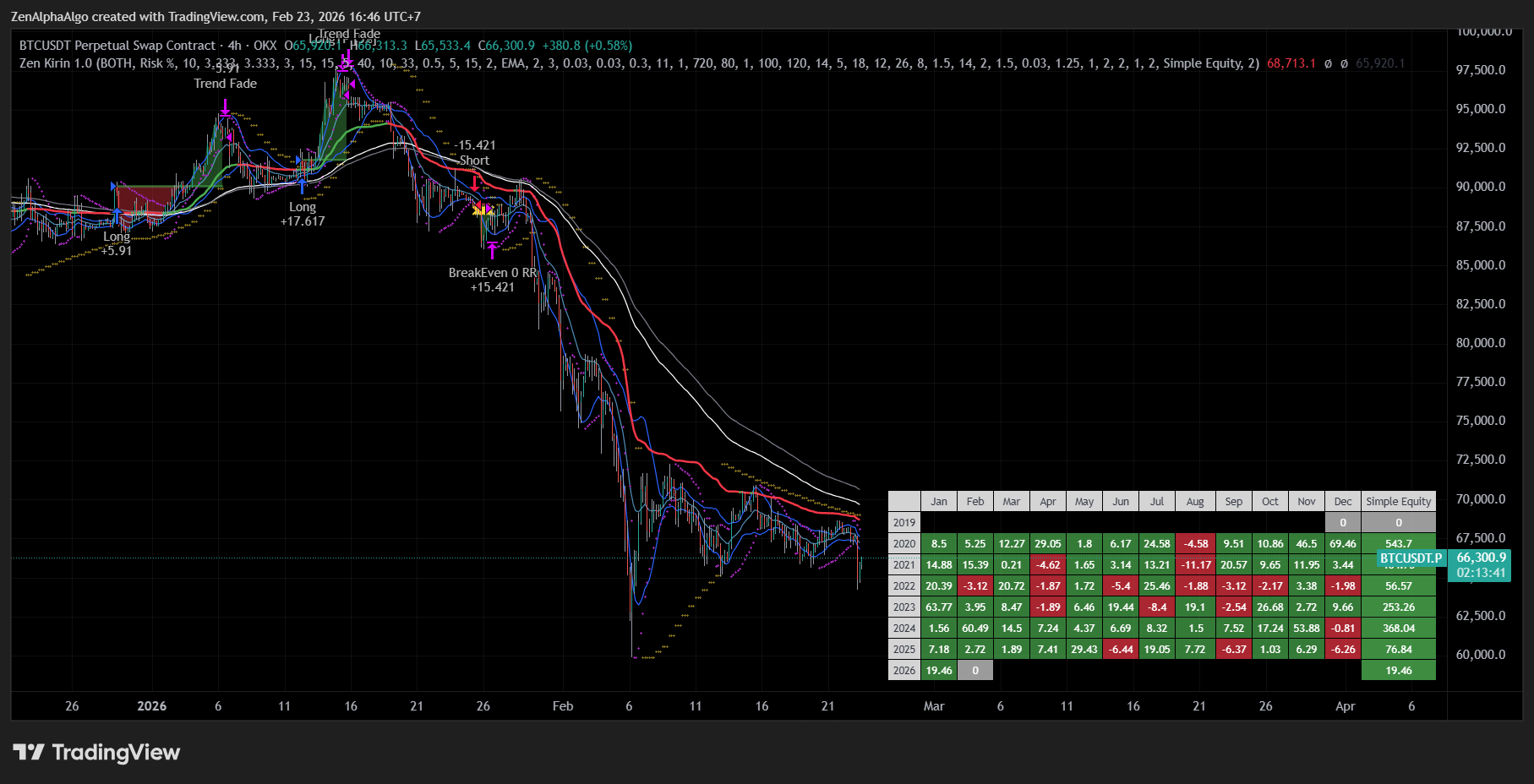
Kirin
The Adaptive Trend System
Kirin is the evolution of Pegasus. It introduces additional logic designed to better handle ranging environments while still maintaining a trend-following core.
By improving participation during transitional market phases, Kirin significantly increases overall system efficiency.
Key Traits
- Adaptive entries
- Better performance during market transitions
- Highest overall efficiency
One Philosophy. Three Temperaments.
Some traders prefer patience.
Others prefer efficiency.
ZenAlpha allows traders to choose the approach that matches their style—or combine them for a more complete framework.
The Three Traps of Strategy Failure
Most strategies fail not because the logic is wrong, but because the backtest was an illusion.
Look-Ahead Bias
Strategies using future market data that wouldn't have been available at the time of the trade. Results in fake accuracy.
- Signals generated only after candle close
- No lookahead or repainting logic
- Backtests reflect only confirmed data
Execution Illusions
Assuming perfect fills at mid-candle prices. Real markets execute sequentially with slippage and imperfect fills.
- Exits avoided via unrealistic intra-price
- Signals based on confirmed volume profile
- Evaluated under practical fill assumptions
Overfitting Trap
Tuning parameters until the historical chart looks perfect. Over-optimized systems fail when markets change.
- Parameters kept intentionally simple
- Prioritizing structural market behavior
- Designed to adapt across environments
Beyond
Linear Histories.
Do not rely on a single historical path. Our **Monte Carlo Engine** simulates 1,000+ alternative market futures to identify tail risks before you deploy.
Integrity Rank
Detecting survivorship bias and strategy repainting.
Tail Risk Analysis
Mathematically calculating worst-case drawdown probabilities.
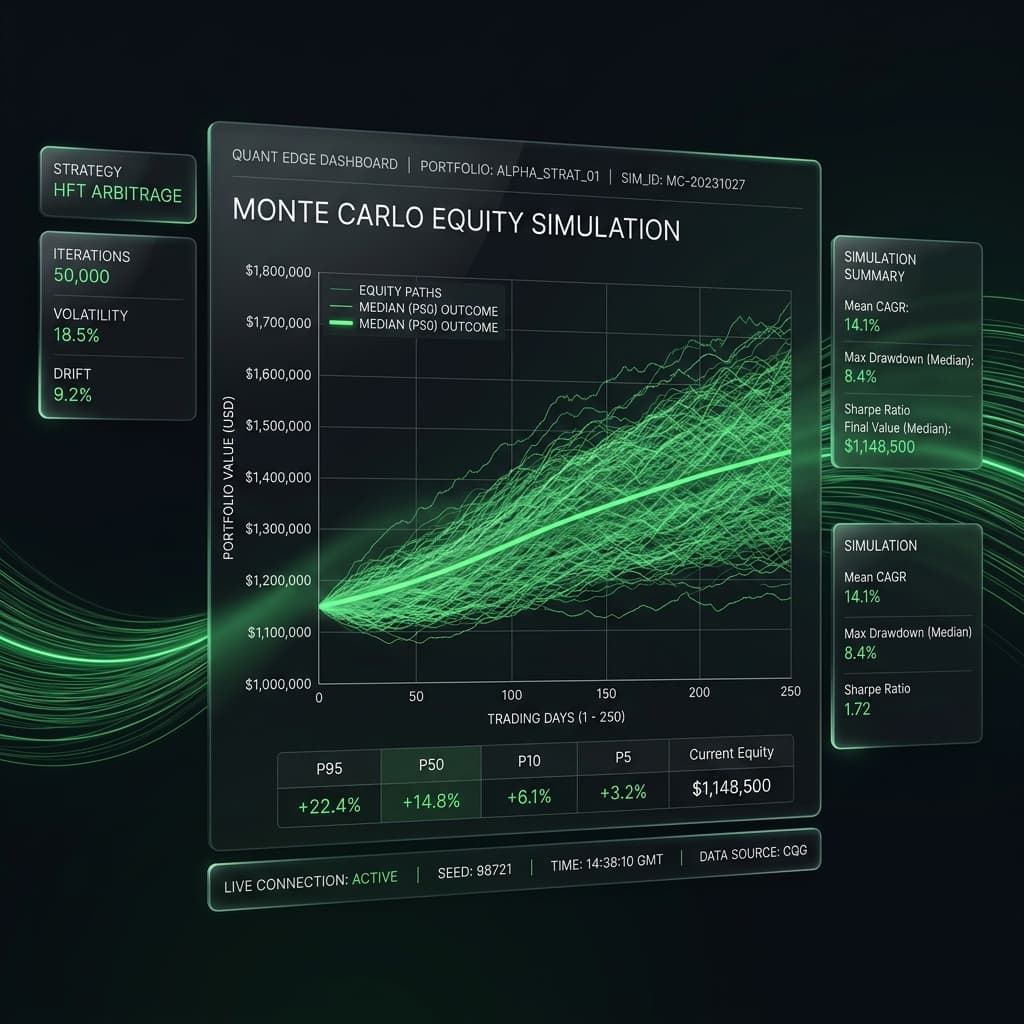
Statistical Confidence
💎 98.4% Integrity
Ruin Prob.
0.02%
ZenAlpha Research Principles
The Design Philosophy Behind ZenAlpha
At ZenAlpha, strategies are developed using a research-driven approach that prioritizes robustness, clarity, and real market behavior.
Instead of chasing the most impressive backtest numbers, the focus is on building systems that can operate consistently across changing market conditions.
Rule-Based Design
Signals are generated based on clear, objective market conditions, eliminating discretionary interpretation and emotional bias.
Execution Realism
Strategies are built with realistic market behavior and order execution constraints to ensure consistency between testing and live trading.
Robust Parameters
Avoiding aggressive over-optimization in favor of stable parameter ranges that remain effective across multiple market environments.
Trend Persistence
Designed to capture structural market movements and persistent directional phases rather than reacting to minor fluctuations.
"The objective of ZenAlpha is not to produce the most attractive backtest,
but to develop strategies capable of navigating real market dynamics."
ZenAlpha Strategy Stack
The Architecture of the ZenAlpha System
At ZenAlpha, strategies are not built as isolated indicators. Instead, they are structured as a multi-layer decision framework, where each layer serves a specific role.
Market Structure
— Understanding the market environmentThe first layer evaluates the broader market structure to determine whether conditions favor trend continuation or consolidation. This prevents the strategy from reacting blindly to short-term fluctuations.
Signal Generation
— Identifying potential opportunitiesOnce the market structure is identified, the signal layer detects high-probability setups based on defined market behaviors. Signals are generated using rule-based conditions, ensuring consistency and objectivity.
Trade Execution
— Confirming entries and exitsThe execution layer determines when a signal should translate into an actionable trade. This layer incorporates timing considerations and avoids unrealistic assumptions commonly seen in simplified backtests.
Risk Control
— Managing downside exposureThe final layer focuses on capital protection. Risk management rules define how positions are sized and when trades should be exited if conditions change. The objective is to maintain controlled risk while allowing profitable trades to develop.
"By separating market analysis, signal generation, execution, and risk control
into independent layers, ZenAlpha creates a structured and disciplined trading framework."
ZenAlpha Strategy Deployment
From Strategy Logic to Real Market Execution

Strategy Logic
- Quantitative Analysis
- Rule-Based Signals

Signal Generation
- Confirmed Market Data
- Clear Trade Signals

TradingView Alerts
- Automated Notifications
- Webhook Integration

Trade Execution
- Exchange Orders
- Automated Trading
A Seamless Trading Workflow
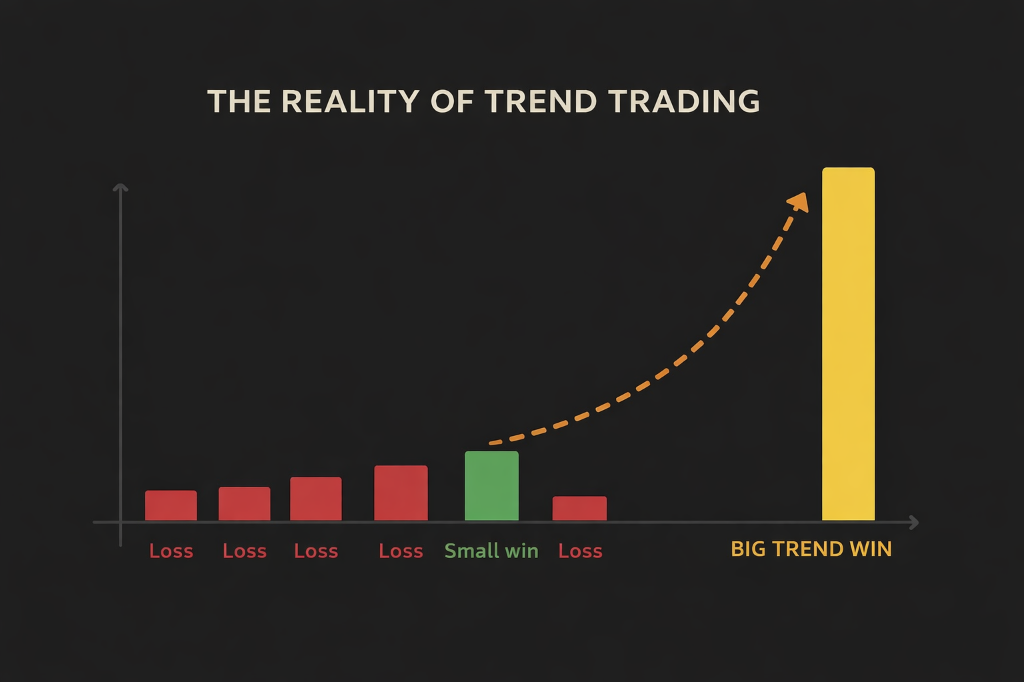
The Reality of
Trend Trading
Successful trend systems accept small losses to capture large moves.
Not Every Trade Is a Winner
Trend-following strategies are not designed to win every trade. Markets spend a large portion of time moving sideways.
During these periods, trend systems may experience several small stop-outs while waiting for a meaningful directional move.This behavior is normal and expected.
Small Losses, Large Winners
The core principle of trend trading is simple: Cut losses quickly. Let winning trends run.
Most trades may result in small losses or modest gains, but when a true market expansion occurs, the system is designed to capture a significant portion of the move. These larger winners compensate for the smaller losses.
The Strategic Edge
Key Insight: Typical trend systems win only 35–45% of trades, but the winners are significantly larger than the losers.
Most strategies try to maximize win rate.
Trend-following systems optimize for something far more powerful:asymmetric returns.
A small controlled loss is acceptable if the system is positioned to capture a much larger move when the market trends.
The ZenAlpha Approach
Capturing large market expansions.
Engages trends more frequently through structure.
Adapts participation across changing environments.
Different temperaments — the same trend-following principle.
Built on Quantitative Principles
Inspired by professional trend-following frameworks
used by systematic trading firms.
Transparency
No black boxes. Logic is based on identifiable price behavior and volatility structures.
Discipline
Rule-based execution removes the destructive influence of human emotion and bias.
Consistency
Designed for long-term survival and participation across diverse market cycles.
Designed for transparency, discipline, and long-term consistency. ZenAlpha bridges the gap between retail tools and institutional-grade logic.
Automate Your Strategy
ZenAlpha strategies can be fully automated using TradingView alerts and supported exchanges.
TradingView generates signals, while exchanges execute trades automatically.
TradingView Account
An active subscription (Essential or higher) to enable real-time Webhook alerts.
Exchange Account
A funded account on OKX or Bitget. These exchanges provide excellent support for tradingview signal bot execution.
ZenAlpha Strategies
Your choice of Arion, Pegasus, or Kirin to bridge the gap between analysis and execution.
Supported Exchanges
Sign up through the links below to receive up to 20% rebates
Why 3-Month Access?
ZenAlpha strategies operate primarily on the 4H timeframe.
To properly evaluate a systematic trading strategy, a sufficient sample size of trades is required.
A 3-month period allows traders to experience multiple market conditions and better understand the system's behavior.
Frequently Asked Questions
Common questions about getting started with ZenAlpha.
Do I need TradingView?
How do I access the strategies after purchase?
Are there any additional costs for automation?
Yes. To automate trades, you will need:
- A TradingView Essential plan (to enable webhook alerts)
- A trading account with OKX or Bitget
Automation is optional. You can also execute trades manually based on the strategy signals.
ZenAlpha provides the strategy logic (“the brain”), while TradingView and the exchanges provide the infrastructure for signal delivery and trade execution.
Do ZenAlpha strategies repaint?
No.
ZenAlpha strategies are built with a strict Zero Future-Peeking principle. All calculations are performed using closed-bar data only.
This means the signals shown in backtests are consistent with how the strategies behave in live markets.
Why is access sold in 3-month periods?
Can I cancel anytime?
Is this financial advice?
Can strategies guarantee profits?
Trade with
Systematic Discipline
Join traders using ZenAlpha strategies to approach crypto markets with structure and clarity.
The future of retail trend-following